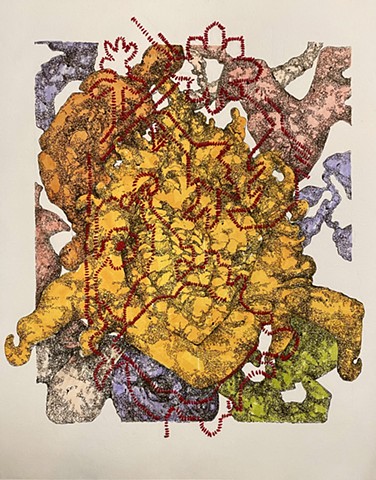
The Persian rug is my native language—the visual system I absorbed before I had words to question it. Growing up in Iran, the rug was not merely decoration; it was the ground of my entire childhood. It witnessed my homework, my play, my happiness and sadness. It was the constant, patterned backdrop against which all my early experiences unfolded. When I left Iran, I carried this visual language with me, even as I was forced to rebuild my life repeatedly in new countries, new cultures, new languages.
For more than a decade, I have worked with the Persian rug as both a formal system and a personal archive. The rug’s geometric logic—its grids, borders, hierarchies of pattern, the requirement that every motif occupy its designated place—represents something far larger than textile design. It is a model of how identity itself is constructed: through repetition, through constraint, through the absorption of inherited codes before we are old enough to consent to them.
My work does not critique the rug. Rather, it uses the rug’s language to ask: what happens when we become aware of the systems that have shaped us? What is the relationship between cultural inheritance and individual agency? Can transformation occur within constraint, or must we destroy what contains us?
The Persian Rug Series transforms geometric motifs into organic, cellular forms. Eyes emerge from within these masses—not in rebellion, but in awareness. Stitching pierces surfaces, embedding salvaged fibers from worn rugs directly into the paintings. These fibers are not ornamental; they are material evidence of time, use, and survival. They are witnesses.
My practice is rooted in the understanding that we are not free agents creating ourselves from nothing. We are shaped—by place, by time, by family, by culture, by the accidents of birth. This shaping is not purely oppressive; it is also what gives us language, beauty, and belonging. The work explores the paradox of being simultaneously imprisoned and alive, constrained and resilient.
As an Iranian-American artist working in diaspora, I understand identity not as fixed but as fluid—accumulated across countries, languages, and ruptures. Each displacement has marked me. Each restart has changed me. My work proposes that awareness of these forces, combined with intentional choice, creates a different kind of freedom than escape. It is the freedom of the eye that sees, the hand that transforms, the spirit that blooms within whatever soil it finds itself planted in.
The Persian Rug Series is about what it means to be human in a world of inherited structures. It is about resilience. It is about the slow, patient work of becoming yourself while honoring what made you.